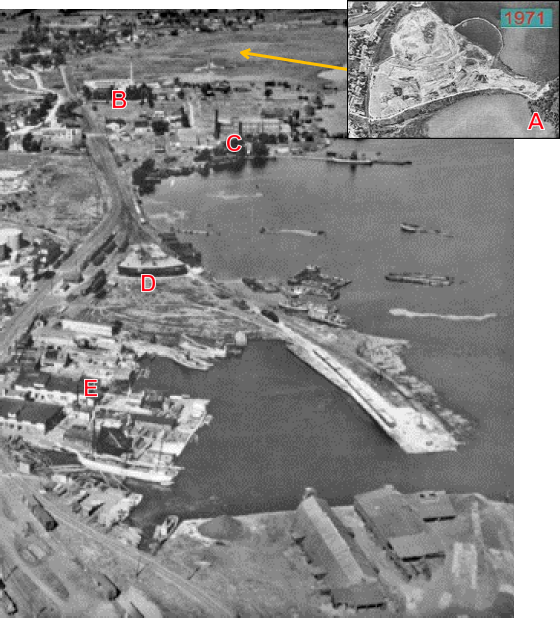
Historical contaminating industries within the KIH included:
Former Belle Park landfill (A)
Tannery and smelting operations (B)
Manufacturing / fabrication mills (C)
Railyards (D)
Shipyards (E)
Upland coal gasification plant and fuel depots
The historically-dominant sources of contamination have since been replaced by newer and cleaner site uses, but their legacy remains in the sediment chemistry. Sediments are a sink for past inputs, and those inputs do not clean up rapidly under natural conditions. The activity from these sites deposited metals directly into the harbour or washed metals into the harbour with surface water or ground water. The elevated metals include chromium, mercury, arsenic, lead, and copper.
Polycyclic aromatic hydrocarbons (PAHs) and polychlorinated biphenyls (PCBs) are contaminants that are also in the harbour because of historical activities. They are mainly from the Belle Landfill, the coal gasification plant, and the former rail yard.
Studies have concluded that there is a risk of people and wildlife (fish, birds, mammals, turtles, aquatic life) experiencing negative health effects if they are exposed to this contaminated sediment. Despite several decades of time for natural recovery, many areas have not recovered enough to be safe for wildlife or uses by people (such as wading).
History of Kingston Inner Harbour sediment contamination and how sediments move in the harbour
The overall goal of the Project is to reduce chemical risks posed by contaminated sediments to humans and ecological groups (e.g., fish, wildlife, turtles, and their food resources) to an acceptable level while ensuring the protection of wildlife habitats (e.g., shoreline turtle habitat), archaeological values (e.g., shipwrecks and cultural artifacts), infrastructure (e.g., harbour walls, underwater utilities), and recreational values. This will require remediation of some areas in the Kingston Inner Harbour, focusing on the sediment where most of the chemicals are found.
The goal of the Project is not divestiture, but rather to meet the federal government's commitment to manage contaminated sites in a responsible manner. The project follows the federal program, called the Federal Contaminated Sites Action Plan (FCSAP), which aims to reduce the environmental and human health risks and associated federal financial liabilities at known federal contaminated sites. The program uses a systematic process to evaluate sites under federal responsibility and make management decisions. Although not a goal of the project, any future property transfers related to the Kingston Inner Harbour would follow the federal circulation process (described in Treasury Board’s Directive on the Management of Real Property), where the property is first offered to other Federal Departments, Provincial Corporations, Municipalities and Indigenous groups for continued public purpose use.
Sediment is the soft solid material that lies under the water at the bottom of a harbour, lake, or stream. Similar to how soil can move with the wind and rain, sediment also moves and mixes over time from waves, water currents, or disturbance by people and animals.
Sediment contamination is the presence of chemicals in sediment at levels higher than they would normally be. Many chemicals are naturally occurring, so the presence of a chemical in sediment does not necessarily mean that contamination exists. If there is contamination (chemicals that are in the sediment in higher-than-normal amounts), it is not necessarily dangerous for people or wildlife. Determining if contaminated sediment is safe or not depends on the area, the types of chemicals, the amounts of these chemicals, and the site uses.
Past studies of water quality of the harbour have found that the water quality is good compared to provincial and federal guidelines designed to protect people and wildlife. The main concern is the contaminated sediment that may be harmful to people and wildlife.
The chemicals of concern in the sediment fall into a few main categories: metals, PAHs and PCBs.
Metals (such as chromium, copper, mercury, and arsenic) in different locations across the harbour match the types of metals used in the past from nearby industries.
Polycyclic aromatic hydrocarbons (PAHs)—this is a group of related chemicals that are commonly present in fuel products. For example, the former coal gasification plant in downtown Kingston released PAHs in the wastes related to plant operations.
Polychlorinated biphenyls (PCBs)—this is a group of organic chemicals containing chlorine, historically used as coolants and lubricants, for which production has been banned North America. They are long-lasting, resist chemical breakdown, and accumulate in the bodies of animals.
We’ve heard concerns about disturbance of buried chromium in Kingston Inner Harbour (KIH) sediments. These concerns generally fall in the following three categories:
Concern about physical mixing of sediments through dredging causing buried contaminants like chromium to be exposed.
Concern about the form of chromium at depth, and potentially with different properties than surface sediments.
Concern about trivalent chromium chemically converting to hexavalent chromium in a highly oxygenated environment.
The conditions of KIH chromium exposure, both under existing conditions and during sediment dredging, are not likely to lead to the creation of more toxic forms of chromium. This is a complex scientific topic, but the following three paragraphs explain why dredging does not raise major concerns about future chromium exposure.
Physical Mixing - Sampling has shown that the surface sediments of KIH are well mixed such that chemicals like chromium, which are no longer being generated from nearby industry, are not consistently found in distinct isolated layers or depths. Sediment transport has caused these chemicals to be spread both horizontally and vertically over time. Dredging programs use controls to limit further mixing and prevent chemicals from spreading downstream as they are removed. The Project design also includes adding cleaner materials to dredged areas to help reduce risks from newly exposed sediment layers. Keep in mind, mixing occurs naturally in the harbour without dredging. Over many years, natural processes like water movement and wildlife burrowing have moved and mixed sediments over many decades to result in the current patterns of sediment contamination. It is those same processes that caused contaminants to be spread broadly throughout the harbour in the past, well beyond the areas where they were originally introduced.
Current Chromium Speciation - While chromium can exist in different forms that affect how it moves into organisms or causes harm, the data show that in KIH, over 99% of the chromium in all layers is in a stable form called trivalent chromium (Cr-III). The sediment profiles show that elevated levels of chromium are found throughout sediment profile, including at the surface. There is no deep layer of harmful hexavalent chromium (Cr-VI) that would be exposed during dredging. The sediments in KIH are a mix of layers rather than separate, stable layers, and this natural mixing has kept chromium in a trivalent form throughout the upper sediment layers.
Chemical Transformation Potential - Layers of sediment with hexavalent chromium dominance would not develop with the Project, either during or following dredging. Given the remediation work is taking place over a relatively short period of time (i.e., scale of months for each management unit), and with backfilling of cleaner materials on top of the post-dredge surface, there is not enough time for the transformation of trivalent to hexavalent chromium. Amanatidou (2023) describe the environmental conditions that cause transformation of chromium in natural environmental media, and conclude that:
Hexavalent chromium reduction to trivalent chromium in water with soil and sediment is very rapid, whereas any reduced chromium in soil and sediment is resistant to reoxidation to the Cr-VI form.
Trivalent chromium species have very low solubility in most environmental conditions; therefore, although hexavalent chromium is detectable in natural surface waters, contact of surface water with trivalent chromium in sediments will not liberate significant additional chromium into the water column. Trivalent chromium is highly immobile under conditions where near neutral pH conditions are present.
Conversion of trivalent chromium to hexavalent chromium in natural environments does not occur simply by exposure to oxygen or from physical disturbance of sediments. Reduction and oxidation (redox) reactions that could convert trivalent chromium to hexavalent chromium “are almost negligible by dissolved oxygen” and such reactions become common only in the presence of an oxidizing agent such as manganese oxide.
The conditions required for transformation to hexavalent chromium requires very high redox potential, and although such conditions may occur in deep groundwater aquifers, they are not typical of shallow river sediments.
Amanatidou E. 2023. Speciation, Chemistry, Geogenic Formation and Dispersion of Chromium in Groundwater. In: Kumar N, Walther C, Gupta DK (eds), Chromium in Plants and Environment. Environmental Science and Engineering. Springer, Cham.
Metals in the harbour that are elevated include chromium, mercury, arsenic, and copper. These metals mainly came from historical industry along the harbour front, by either being directly deposited or washed into the harbour with surface water or ground water. For example, chromium in the harbour comes from the chrome tanning process used at the Davis Tannery that was immediately next to the harbour for much of the 20th century. Metals in the harbour can pose both ecological and human health risks depending on the type and where they occur.
PAHs occur naturally in coal, crude oil, and gasoline, and are produced from burning. PAHs are a common contaminant in urban waterways, and come from numerous sources, including storm sewer outlets from road run-off, automobile exhaust, furnace/stack emissions, or spills from fuel depots/marinas. Historical coal stockpiles, oiling docks, and rail yards in Kingston Inner Harbour, along with the former coal gasification plant in downtown Kingston, are thought to be the most significant sources of PAHs to the harbour. These chemicals break down naturally (i.e., biodegrade) in the environment, but this process can take a very long time depending on the type and amount of PAHs present. PAHs in the harbour can pose risks to both ecological and human health.
PCBs are human-made chemicals that were used widely in electrical equipment like capacitors and transformers, and previously found in hydraulic fluids, heat transfer fluids, lubricants, and plasticizers. PCBs were mostly washed into the harbour with surface water and groundwater running through the former Belle Landfill. Because they can cause negative health effects at low levels in people and wildlife, the import, manufacturing, and sales of PCBs were made illegal in Canada in 1977. In Kingston Inner Harbour, PCBs were most likely released into the environment through leaks from a former landfill, scrap yard, and demolition yard. Once in the environment, PCBs stick to soils and sediments and can be transported long distances from their original source. They also bind strongly with fatty animal tissues and magnify in the food chain, meaning they are passed into and accumulate in larger animals when they eat smaller animals. These chemicals break down (i.e., biodegrade) very slowly and can last a very long time in the environment. PCBs in the harbour can pose risks to both ecological and human health.
What ongoing sources are there and how are they controlled?
No, there are no ongoing sources of contamination from historical sites. Understanding and addressing the potential for recontamination is essential for contaminated sites projects. Most of the contamination in the harbour resulted from historical activities in surrounding areas. Left-over contamination in most of those surrounding areas is being managed, or planned for management, which will help prevent future contamination of the harbour. For example, a groundwater system was installed at Emma Martin Park to prevent metals from moving into the harbour, and a leachate management system was installed at the former Belle Park landfill to collect water moving through the landfill and stop PCBs from leaving the landfill site.
The conceptual sediment management plan recognizes that Kingston Inner Harbour is a working harbour, so it could continue to receive new inputs from active uses (e.g., storm water, boat traffic, fuel spills). For that reason, the goal of the plan is to manage the contamination to lower, more acceptable risk levels, not to remediate to pristine conditions. Ongoing sources are not expected to worsen conditions beyond the safe level, and the current environmental regulations and best practices will reduce the likelihood of new contamination. After dredging and sediment capping is complete, the harbour will be monitored long-term to provide confidence that the remaining concentrations of chemicals will stay the same or decrease over time. The federal government is working with the City of Kingston to monitor street runoff and other inputs from storm sewers, and to provide confidence that ongoing flows do not threaten the health of the harbour.
Overall, water quality in Kingston Inner Harbour (KIH) is considered good. This is because a large proportion of the chemicals found in KIH are tightly bound to the sediments and do not easily dissolve in surface water. Even though there are some chemicals in KIH water that are higher than in upstream areas, they aren't at levels that need any extra actions, other than what has already been planned for this project.
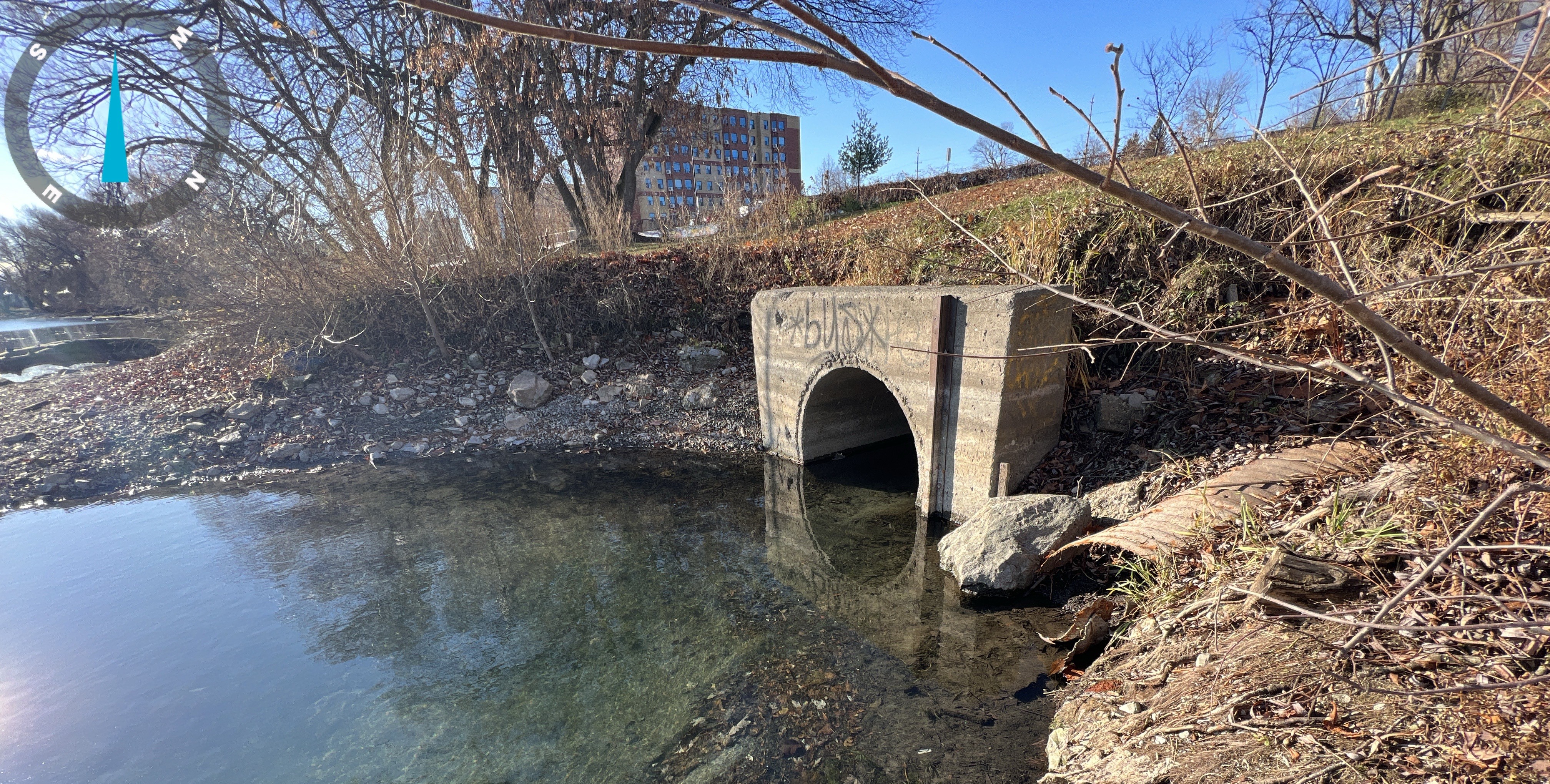
To further understand the impact of different weather conditions (such as rainfall) on KIH water quality, and check for emerging contaminants and source controls (controlling pollutants at their source), we recently collected additional water quality and sediment samples from storm sewer outlets, including the one flowing into Orchard Street Marsh (Kingscourt stormwater discharge). We have analyzed results for legacy contaminants (the former industrial sources), nutrients (agricultural inputs), and emerging contaminants (chemicals such as fire retardants associated with urban activity not associated with former industry). These results show evidence of source control, confirm stormwater quality for discharges to KIH, and provide information used for design of the Project. Water quality monitoring information will be shared with the City of Kingston for consideration in their regional program of municipal source controls and stormwater management.
Have more questions? Please visit the Q&A page for the project for the full list of questions and answers.